
Adversarial Insights Blog
Here’s the One Assumption Your Entire Security Program Is Built On, and Why It’s Wrong
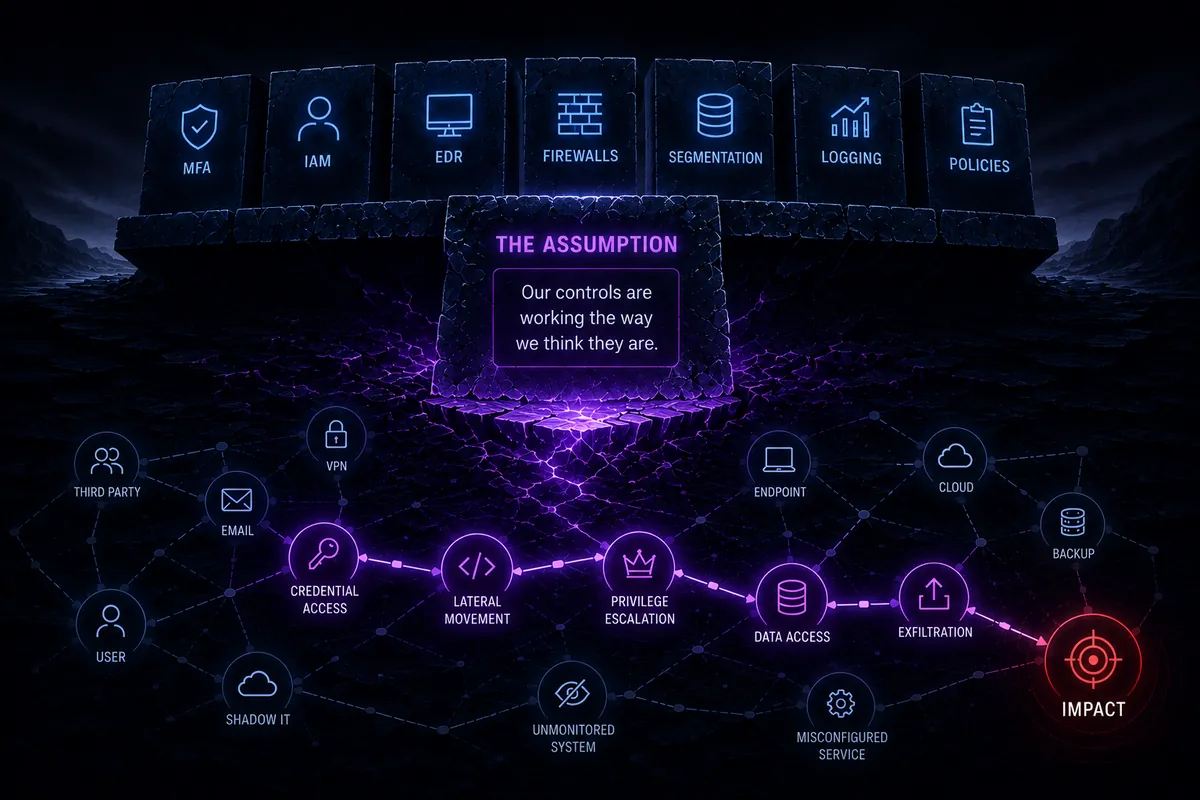
Here’s the One Assumption Your Entire Security Program Is Built On, and Why It’s Wrong
Most security programs are built on a hidden assumption.
The assumption is this:
If we implement enough controls, we are secure.
It sounds reasonable. It is also wrong.
Why This Assumption Fails
Controls matter. But controls alone do not create security.
Many breach stories contain the same pattern:
- The control existed, but was misconfigured.
- The alert existed, but no one acted on it.
- The policy existed, but no one followed it.
- The scan existed, but findings were never prioritized.
The issue was not always missing controls.
The issue was assuming controls automatically equal protection.
Security Is Not What You Installed
Many organizations measure security by inventory:
- How many tools do we have?
- How many alerts do we generate?
- How many findings did we close?
These are activity metrics.
They are not outcome metrics.
Attackers care about:
- What can be bypassed
- What is trusted without validation
- What no one owns
- What has drifted quietly over time
That is where real risk lives.
The Real Assumption Underneath Everything
The deeper assumption is this:
Our controls are working the way we think they are.
Because in live environments:
- Permissions expand
- Exceptions accumulate
- Systems age
- Logging changes
- Pipelines evolve
- Shadow IT appears
Controls degrade unless they are actively tested.
What Mature Security Programs Understand
Security is not a set of controls. Security is a system of continuous validation.
That means asking:
- If one employee is phished, how far can that identity go?
- If CI/CD is compromised, what stops production impact?
- If an attacker moves laterally, how quickly would we know?
- What trust assumptions have we never tested?
Final Thought
A control is only valuable if it works when someone is actively trying to break it.
Everything else is theater.
Want a clearer picture of where your program relies on broken assumptions?
Adversarial Insights helps organizations identify hidden trust gaps, real attack paths, and where security breaks under pressure.
If this resonates, reach out.